
The Founder HandoverBuild a sales engine that runs without you.
A 90-day system for owners who are still the best salesperson in the company — and are now the reason it cannot grow.
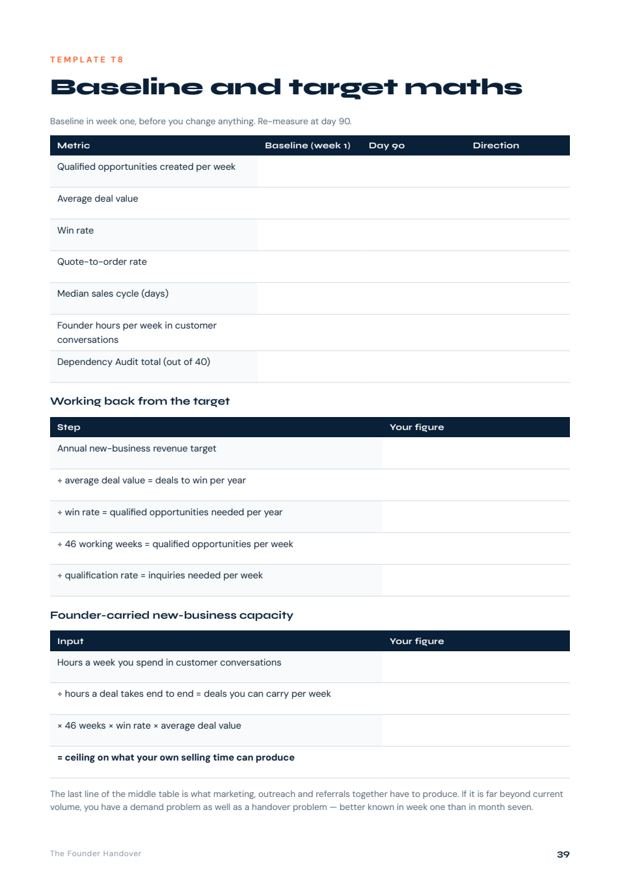
What your own selling time can carry
Exhibit 011.67 deals a week × 46 selling weeks × win rate × deal value.
This is the ceiling on new business your own calendar can produce — not total company revenue. Repeat orders, contracted revenue, channel partners and other sellers sit outside it. Most owners find the figure lands close to the new business they actually won last year. Chapter One.
Founder-led selling is not a bad habit. It is an early advantage that stops working at a predictable point.
In the first years you are the fastest path to revenue: you carry the context, the credibility and the authority to say yes. Then volume arrives, and the company can only process as many opportunities as you can personally touch.
| What owners believe | What is actually true | Transferable? |
|---|---|---|
| “Only I understand the product deeply enough.” | Depth matters in a minority of conversations. The rest follow a pattern that has never been written down. | Yes — Transfer Two |
| “Customers want to speak to the owner.” | They want authority and speed. Both can be delegated with explicit decision rules. | Yes — Transfer Five |
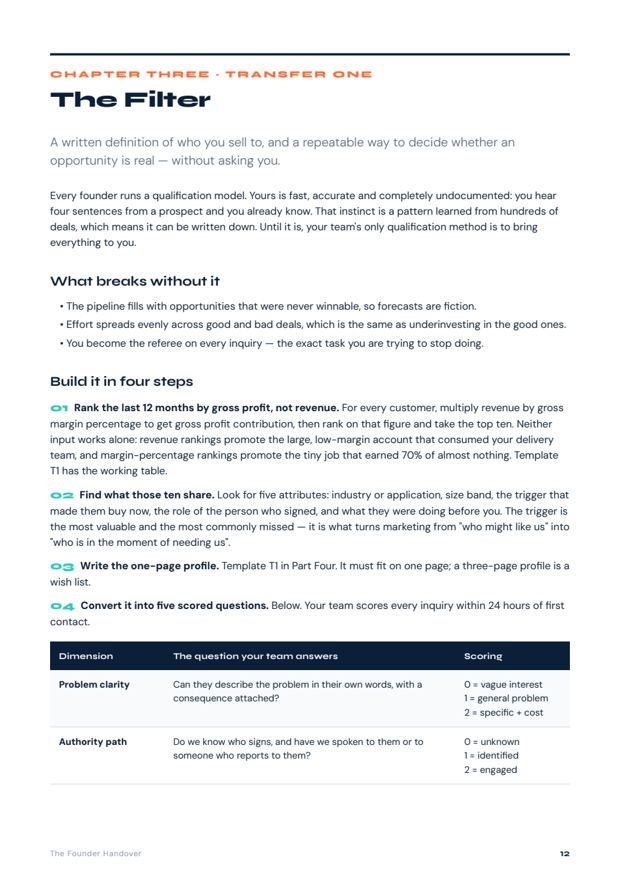
| “I can tell which deals are real.” | You are running an unwritten qualification model. It can be extracted into five scored questions. | Yes — Transfer One |
| “Key relationships are personal to me.” | Partly true. A small set of accounts genuinely belongs with you — the failure is keeping the list informal. | No — keep, but name them |
Three of the four are documentation problems, not judgement problems. The book treats them in that order.
You do not hand over “sales”. You hand over five assets, in order.
Each transfer ends in a document, and each has a test that tells you whether it actually moved. Later transfers depend on earlier ones, so the sequence is not optional.
| Transfer | What breaks without it | The document you produce | Proof it transferred |
|---|---|---|---|
| OneThe Filter | Everything becomes an opportunity, forecasts turn to fiction, and you referee every inquiry. | A one-page best-fit profile and a five-question scorecard, with three hard disqualifiers. | You and your receiver score ten inquiries separately and land within one point on eight. |
| TwoThe Conversation | The first meeting degrades into a product demonstration. The buyer leaves informed and unmoved. | Five message blocks, twelve questions, and the rule that no quote leaves without four recorded facts. | You can predict the outcome of three calls your receiver ran as confidently as your own. |
| ThreeThe Follow-Up | Quotes go quiet and are abandoned by both sides. The conversion gap is usually the largest recoverable pool of revenue in the business. | An eight-touch, 21-day cadence with a reason for every contact, plus a close-out rule. | Four consecutive weeks with no open opportunity missing a dated next action. |
| FourThe Numbers | Decisions get made on the loudest recent event, and month end is a surprise. | Five metrics with baselines, the target working, and five stages defined by buyer evidence. | Your receiver states all five numbers at a review you did not prepare for. |
| FiveThe Judgement | Buyers learn to wait for you on price. One negotiation is enough to teach them, and the handover becomes decorative. | An authority matrix with written limits, a price floor, four escalation triggers, and a capped list of accounts you keep. | Thirty days in which no pricing question reaches you that the matrix already answers. |
Ninety days, and a test at the end you cannot argue with.
Month one produces documents and a baseline. Month two moves the work across in four steps. Month three removes you deliberately and measures what happens.
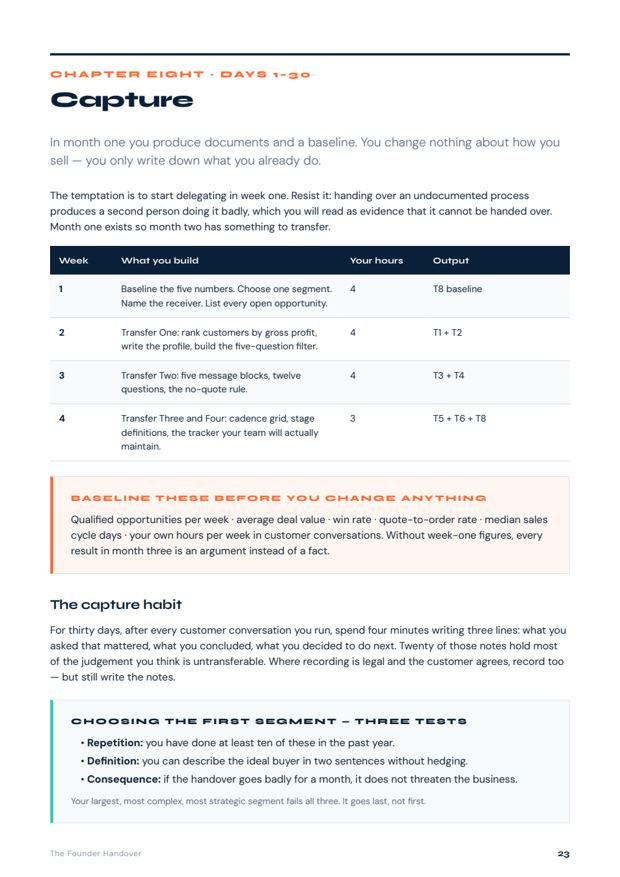
Capture
You change nothing about how you sell. You write down what you already do.
- Baseline five metrics and your own selling hours
- Choose one repeatable segment
- Name the person receiving it
- Build the filter and the conversation guide
Shadow and swap
Four steps, two weeks apart. Skipping one is the most common reason a handover collapses later.
- You run it, they observe
- You run it, they own one part
- They run it, you stay silent
- They run it, you read the notes
Release and verify
Ten consecutive working days in which you take no sales decisions inside that segment.
- Did anything stall waiting for you?
- Did realised margin move?
- How many escalations were already answered in writing?
- Re-score the audit against day one
The operating rhythm
Thirty minutes a week is what holds the whole structure in place.
- Six questions, same day, same time
- Nothing leaves the room without an owner and a date
- Monthly numbers review
- Quarterly update of every document
Forty-four pages, written to be worked through rather than read.
Four parts and twelve chapters, ending in a toolkit you fill in. Clickable contents and PDF bookmarks throughout, so it works on a phone as well as on paper.

Eleven templates. A blank one is a book; a completed one is a system.
Deliberately paper-shaped. Fill them in by hand or in a spreadsheet, and only move them into software once the process has survived a month.
Whether this fits your business right now.
Written for
- B2B, SME and growth-stage firms roughly between $300K and $10M in annual revenue
- Owners still personally involved in most deals
- Services firms, manufacturers, distributors and technology companies selling to other businesses
- Anyone who has one person — employee, new hire or fractional leader — ready to receive the work
Not written for
- Transactional retail with no human sales conversation
- Very early businesses where the founder should still be selling everything
- Firms below roughly twenty customer conversations a quarter — there is not enough repetition to hand over yet
- Anyone looking for lead generation tactics rather than a transfer of ownership
Buying from India?The India Edition carries the same system with rupee examples, Indian business context and a local payment flow.
View India Edition →Start with the Dependency Audit.
Twenty statements, fifteen minutes, scored across the same five areas the book transfers. The total tells you how deep the dependency runs; your highest-scoring area shows where the pressure is greatest.
A directional self-assessment, not a diagnostic. It shows where the concentration sits; it cannot tell you what it is costing you.
Questions worth answering before you buy.
What exactly do I receive?
Can my team use it, and can I use it with clients?
How much time does this actually take?
I don't have anyone to hand over to yet. Is it too early?
Will this work outside the US or UK?
Does it promise a revenue result?
Do I get help if I get stuck?
Can a deal progress on a day you are unreachable?
If the honest answer is no, that is a structural constraint, and it will not resolve by working harder inside it. Ninety days is enough to change the answer for one segment.